Dataset Shift Detection in Deployed Clinical AI Models
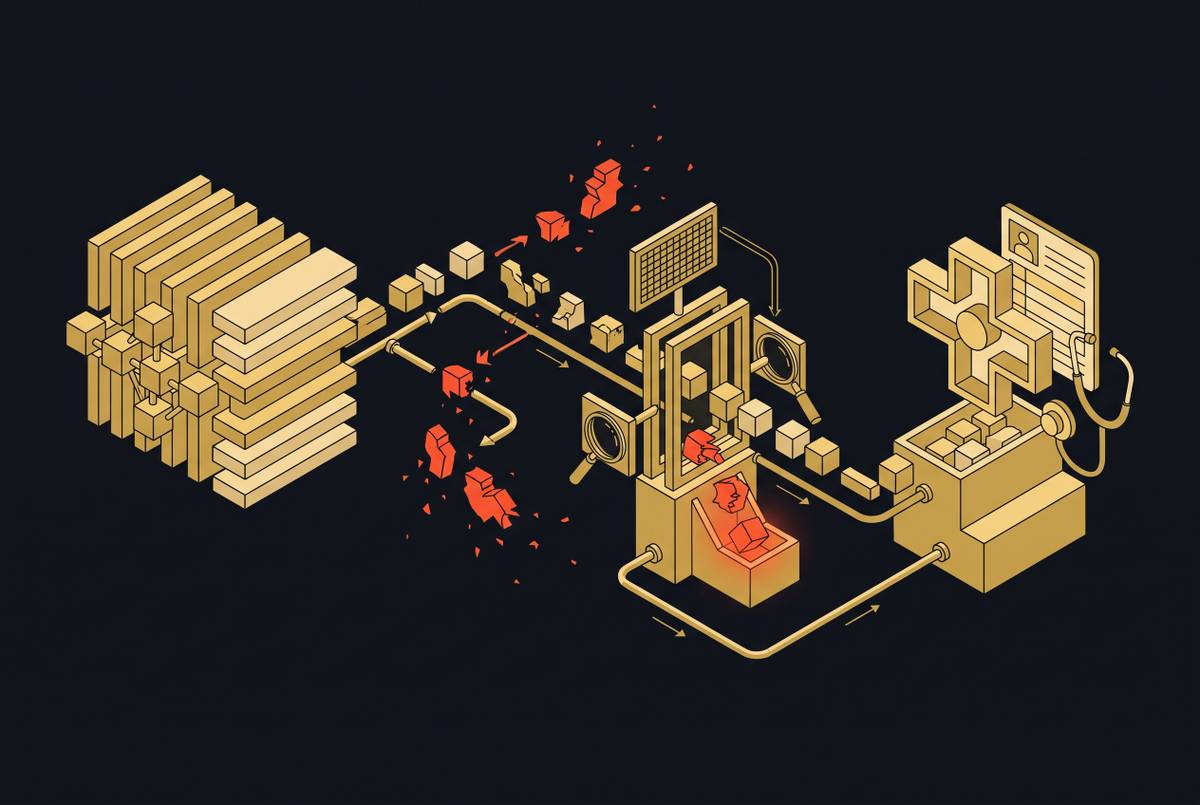
Deployed clinical AI needs monitoring for three distinct types of data shift.

By March 2025, the FDA had authorized 1,016 AI-enabled medical devices for clinical use. That number alone tells you deployment has outpaced oversight in one specific way: most of these systems ship without a real plan for what happens when the data they see in practice stops looking like the data they were trained on. That gap has a name, dataset shift, and it comes in three distinct flavors that get treated as one problem far too often.
The three forms of dataset shift and what each one changes
The literature is a mess on naming conventions. "Population drift," "data drift," "domain drift," and "covariate shift" get used interchangeably across papers, vendor documentation, and regulatory guidance, even though they don't all mean the same thing. Sorting this out matters because the fix for one type of shift can be useless, or actively misleading, when applied to another.
Covariate shift is the case where the distribution of input features, P(X), changes, but the underlying relationship between inputs and outcomes, P(Y|X), stays fixed. A sepsis model trained on patients at one hospital and deployed at another with a different demographic mix, or a different brand of imaging equipment, is facing covariate shift. The biology hasn't changed. The population feeding the model has. This is the one type of shift that matters most operationally, because in real deployment, where ground-truth labels are usually unavailable, it's the only kind you can identify directly without waiting for outcomes to arrive.
Label shift is different: the prior probability of the outcome itself, P(Y), moves, while the relationship between inputs and outputs holds steady. A disease outbreak that suddenly raises prevalence changes the proportion of positive cases a model encounters, even though the model's logic connecting symptoms to diagnosis hasn't changed.
Concept shift is the most dangerous of the three, because it changes P(Y|X) itself. This is the model's learned mapping going stale. New treatment protocols, updated clinical guidelines, or a shift in standard of care can all sever the link between what a model was trained to believe about symptoms and outcomes, and what's actually true now. A model can look fine on paper while quietly reasoning from rules that no longer apply.
How clinical environments generate each type of shift
Real-world events rarely produce just one kind of shift. It helps to organize by mechanism instead, because a single disruption in a hospital system tends to generate covariate, label, and concept shift all at once.
Demographic and institutional variation is the most persistent source. Research on cross-institutional deployment shows that a model trained at one hospital and deployed at another serving a different ethnic catchment area, or using lower-resolution imaging hardware, runs into covariate shift the moment it goes live. Subgroup attributes driving this shift are often unmeasured or simply unidentified in the data. As a result, a monitoring system can look stable in aggregate while quietly failing for a specific patient population underneath.
Pandemics and other acute disruptions compress this timeline from years to weeks. Sepsis detection AI systems showed a 43% increase in alert volume during COVID-19, a shift in label distribution that happened almost overnight. A cohort study out of Toronto hospitals, published in JAMA Network Open, documented shifts tied directly to the pandemic and to changes in laboratory assays for troponin, D-dimer, and BNP, an infrastructure change that alters input distributions without anyone touching the model itself.
EHR and coding system changes round out the list. Transitions between coding standards, like the move from ICD-9 to ICD-10, or evolving documentation habits among clinicians, create covariate shift with zero change in patient biology. The patients are the same. The way their conditions get recorded isn't.
Label availability's role in shaping which detection methods are possible
Most model evaluation assumes you can compare a prediction against a known outcome. In deployed clinical AI, that assumption breaks down constantly. Mortality, readmission, disease progression: these outcomes may not be known for days or weeks after a prediction is made, and in some cases they're never reliably recorded.
The problem compounds when a model's output actually shapes the care pathway a patient receives. If an ML-stratified workflow routes high-risk patients to more aggressive monitoring, the outcome that eventually gets recorded is partly a product of the model's own prediction. That severs the clean link between prediction and ground truth that standard evaluation depends on.
The practical consequence, documented in survey work on clinical AI monitoring, is that comparing model output to ground-truth labels is often infeasible as a day-to-day monitoring strategy. The difficulty of getting timely, unbiased labels is what makes label-agnostic shift detection the primary mode of surveillance in real deployment, not a fallback.
That splits monitoring into two tracks. Label-agnostic methods detect distributional change in inputs or outputs without knowing whether any individual prediction was right, and they're the workhorse of real-world monitoring because they don't have to wait for anything. Label-dependent methods get applied retrospectively, once labels eventually show up, or in settings where outcomes return fast enough to be useful. Both matter, but only one of them is available on day one of deployment.
Statistical methods for detecting covariate shift in EHR and tabular data
For tabular data like EHR records, feature-level monitoring starts with univariate tests. The Kolmogorov-Smirnov test compares the cumulative distribution of a continuous variable between the training window and the deployment window, flagging cases where the two no longer line up. The Population Stability Index does something similar with a fixed rule of thumb attached: a PSI above 0.25 is treated as a standard cutoff for significant drift across the industry. Tools like TensorFlow Extended operationalize this kind of monitoring directly, using L-infinity distance for categorical features and Jensen-Shannon divergence for continuous ones.
The limit of univariate testing is that it checks one feature at a time. A model can degrade because of how two or three features move together, even when no single feature looks abnormal on its own, and univariate tests are structurally blind to that.
Multivariate methods close part of that gap. Two main approaches dominate: two-sample testing, which asks whether the training and deployment datasets could plausibly come from the same distribution, and classifier-based detection, which trains a model whose only job is distinguishing training data from deployment data. If that classifier can tell the two apart with any real accuracy, shift has occurred. Both approaches tend to need dimensionality reduction first, since they perform better on compressed, lower-dimensional representations than on raw feature space.
Maximum Mean Discrepancy is one of the more validated tools here. Subasri et al. applied MMD across 143,049 adult inpatients spread over seven Toronto hospitals, and paired it with a drift-triggered continual learning strategy that recovered a Delta AUROC of 0.44 during the COVID-19 period, a concrete benchmark for what a well-built label-agnostic pipeline can actually claw back once shift is caught.
There's also a more proactive posture available: unsupervised temporal characterization, which looks for shift before a model is even scheduled for retraining. Fernández-Narro et al. used Information Geometric Temporal projections, via the EHRTemporalVariability R package (version 1.2.1), on MIMIC-IV data covering more than 40,000 patients from Beth Israel Deaconess Medical Center. The goal wasn't to catch a model already failing, it was to flag distributional change as an early warning sign, ahead of any measurable performance drop.
One-class SVMs offer another route, particularly suited to settings where the shift is subtle and other methods are either mismatched to the data or too impractical to run continuously. Because the "normal" training distribution in a medical diagnostic setting is usually well characterized, framing drift detection as outlier detection against that known baseline turns out to be a workable shortcut.
Detection methods built for medical imaging, where tabular statistics fall short
None of the tabular methods above translate cleanly to imaging data. The dimensionality is the first obstacle: running a two-sample test directly on pixel data is impractical without heavy compression first. The second obstacle is subtler. A change in scanner manufacturer, image resolution, or patient positioning may barely register in pixel-level statistics while still being fully visible in the learned feature representations a deep model relies on.
Self-supervised encoders are one answer to this. Roschewitz et al. built what's described as the first unsupervised framework capable of not just detecting shift but identifying its type, distinguishing prevalence shift, covariate shift, and mixed shift from one another rather than lumping them into a single alarm. The framework was tested across chest radiography, digital mammography, and retinal fundus images, spanning five types of real-world dataset shift across five large public datasets. Self-supervised encoders catch subtle covariate shifts that the model's own task outputs would miss entirely, since a classifier's final prediction can stay stable even while its internal representation of the input is drifting underneath. The code for this framework is public at github.com/biomedia-mira/shift_identification.
MMC+ takes a different angle, built for scale across multiple sites and modalities. It builds on CheXstray, the framework that introduced real-time drift detection for imaging AI through multi-modal data concordance. MMC+ adopts distance-based statistical measures in place of chi-square tests, a change that makes it more tolerant of the kind of messy, varied data streams multi-site deployments actually produce. It also folds in foundation model embeddings, MedImageInsight among them, to generate high-dimensional image representations without needing site-specific retraining, which is the detail that makes it scale across hospitals rather than needing a bespoke setup at each one. It's been validated against Massachusetts General Hospital data collected during COVID-19, where it detected data shifts that lined up with real changes in model performance. Merkow et al., in an arXiv paper, position MMC+ as an alternative to running continuous performance monitoring for deployments where constant label collection is a constraint.
Imaging surveillance has its own version of hidden covariate attributes that are unmeasured or unidentified in the monitoring pipeline. Research has shown that the subgroup attributes that matter most for detecting shift are frequently unmeasured or unidentified in the monitoring pipeline itself. Site-level monitoring can look perfectly stable in aggregate while a specific subgroup drifts hard underneath, invisible to whatever dashboard is tracking overall concordance. Any imaging monitoring framework needs to be chosen with that blind spot in mind.
Matching detection method to shift type: a decision framework for monitoring design
Detecting that shift occurred isn't the finish line. Knowing which type of shift occurred determines what a team should actually do about it, and picking a mitigation strategy without that diagnosis is close to guessing.
Four questions shape which detection method even makes sense for a given deployment. What's the data modality, tabular EHR data, medical imaging, or some mix of the two, since that alone dictates whether statistical tests, self-supervised encoders, or multi-modal frameworks like MMC+ are the right tool. What's the label availability, near-real-time, delayed by days or weeks, or effectively absent, since that dictates whether performance-based monitoring is even on the table or whether distributional monitoring is the only option. Is there a feedback loop risk, meaning does the model's own output influence the labels that will later be used to judge it, because if so, standard surveillance approaches are biased by design and need to be treated with real suspicion. And what's the temporal horizon: an acute disruption like a pandemic or an assay change behaves differently than slow demographic drift or plain model aging, and that difference should set both the monitoring frequency and the alert thresholds.
For covariate shift in tabular data specifically, the method stack follows a rough hierarchy: KS tests and PSI at the individual feature level, MMD for dataset-level comparisons, one-class SVMs when the shift is too subtle for the others to catch, and IGT projections when the goal is catching drift before it appears as a performance problem. None of these tools replaces clinical judgment, and none of them is optional given how many deployed systems, 91% by one measure of tracked models, show performance degradation over time. The real failure mode is deploying without deciding, in advance, which test applies to which kind of shift, and then discovering the gap only after the model has already gotten something wrong. It's deploying without deciding, in advance, which test applies to which kind of shift, and then discovering the gap only after the model has already gotten something wrong.
Sources
- Keeping Medical AI Healthy and Trustworthy: A Review of Detection and Correction Methods for System Degradation
- JMIR Medical Informatics - Unsupervised Characterization of Temporal Dataset Shifts as an Early Indicator of AI Performance Variations: Evaluation Study Using the Medical Information Mart for Intensive Care-IV Dataset
- arxiv.org
- Unsupervised Characterization of Temporal Dataset Shifts as an Early Indicator of AI Performance Variations: Evaluation Study Using the Medical Information Mart for Intensive Care-IV Dataset
- jamanetwork.com