LLM Hallucination in Clinical Contexts and Detection Approaches
Reasoning failures and omissions pose greater clinical risks than invented facts alone.

Diagnosis by negation and the rest of the house-restricted patterns aside, here's the substance:
What kinds of errors occur: the taxonomy of medical hallucinations
A model that gets a trivia question wrong is a party trick gone stale. A model that gets a drug interaction wrong inside a clinical note is a different animal, because the error is dressed in the same syntax as correct medical reasoning, and nothing about its surface gives it away. Research from MIT, Harvard, and the University of Washington (Kim et al., arXiv:2503.05777) defines medical hallucination as any output that's factually wrong, logically inconsistent, or unsupported by real clinical evidence, in ways that could change a clinical decision. That framing treats hallucination as a decision-quality problem, not a narrow made-up-fact problem, and it's the right framing. Anyone still measuring these systems by whether they invent citations is checking the wrong thing.
Kim et al. developed a typology of medical hallucinations that has become the field's reference point. Factual hallucinations are the easy ones to picture: invented citations, fabricated drug names, clinical trial results that never happened. Reasoning hallucinations run more insidious, because the logic chain holds together step by step and still lands on the wrong clinical conclusion. In the study's physician audit, 64% to 72% of the hallucinations that survived mitigation traced back to causal or temporal reasoning failures, not gaps in medical knowledge. The model knew the right facts and still reasoned its way to the wrong place. That's a worse problem than simple ignorance, because it looks like competence from the outside.
Procedural hallucinations round out the typology: invented or garbled clinical procedures. The source study offers a pointed example, an LLM that hallucinates patient history the same way a physician's own confirmation bias would, quietly suppressing symptoms that contradict the working diagnosis. The model errs in the same direction human cognitive bias already pulls, which makes the mistake harder to catch, not easier.
By 2026 the field had split hallucination further still, into six distinct failure modes reported as separate rates instead of one folded number. A single hallucination percentage quoted without qualification is probably hiding more than it reveals.
Omission deserves its own category, separate from fabrication. Research out of Vanderbilt and Lirio (Ni et al., arXiv:2604.00014), using 2,075 prompts generated through a method called UTCO on Llama 3.3 for mental health counseling scenarios, found omissions in 13.2% of responses against 6.5% for hallucinations, with the worst rates concentrated in the highest-stakes prompt categories. The highest-stakes conversations produced the worst rate of leaving out safety-critical information, and a detection system built only to catch false statements walks right past this failure mode. There's nothing false in the sentence to catch. The response just doesn't say the thing it needed to say.
Why the hallucination figures vary so widely
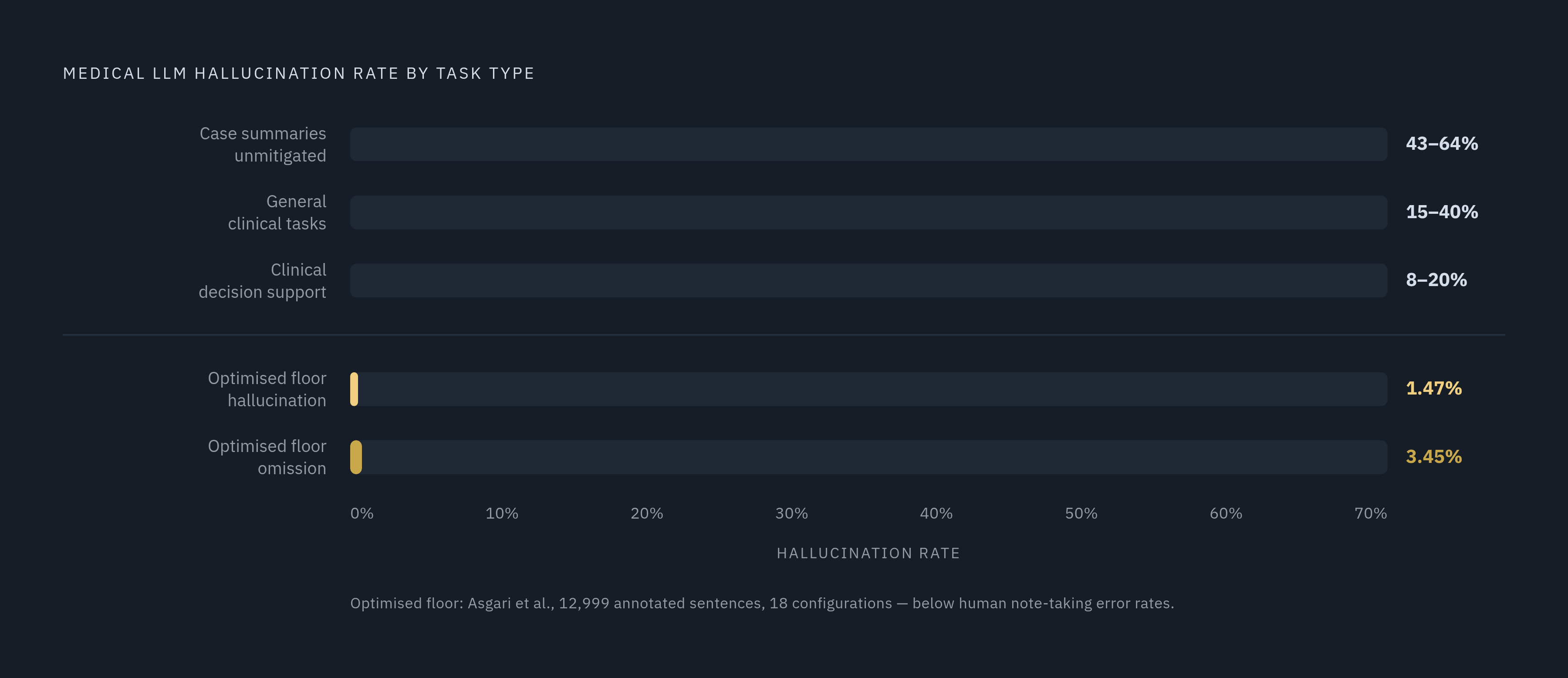
Published hallucination rates on clinical tasks for current medical LLMs run from 15% to 40%. Clinical decision support studies land lower, around 8% to 20%. Unmitigated medical case summaries have been measured as high as 64.1%, with a broader 43% to 64% range depending on how good the prompt was. Anyone citing a single number for "the hallucination rate" in medicine is oversimplifying, whether they mean to or not, and the spread itself is the real finding here: task type is the biggest single lever. Open-ended summarization produces very different base rates than structured question-answering, which differs again from decision support.
Prompt quality moves the needle hard too. Prompt-based mitigation alone cut hallucination rates by roughly 22 percentage points in one 2025 Nature study, and by 33% in another. Model generation matters as well. GPT-5 posted a 9.6% hallucination rate against GPT-4o's 12.9%, a 26% relative drop, and GPT-5-thinking, the extended reasoning variant, brought that down further, to 4.5%. Newer generations are cutting the rate meaningfully. They are shrinking the problem, not solving it, and that distinction determines how much verification users still must do even as the percentages fall.
What optimization can do at the extreme end is visible in a 2025 npj Digital Medicine study (Asgari et al., doi: 10.1038/s41746-025-01670-7) on clinical note summarization. Across 12,999 clinician-annotated sentences and 18 experimental configurations, refined prompting and workflow design got the hallucination rate down to 1.47%, with a 3.45% omission rate, both below previously reported rates of human note-taking error. That's the ceiling of what's achievable today, not the floor of what's typical, and the distance between 1.47% and 64.1% is the whole argument for treating prompt engineering and workflow design as core infrastructure rather than an afterthought bolted on at the end.
A separate, quieter failure sits in the scientific literature itself: hallucinated citations. Rates in controlled experiments ranged from 19.9% to 91.4% depending on the model and the time period tested. For a clinician trying to verify a claim by checking the cited source, that's its own serious problem, since the citation itself might not exist.
Where clinical risk concentrates: oncology, imaging, and mental health
Specialization does not buy safety, and the evidence on this point runs against the obvious assumption. Kim et al. found general-purpose models produced hallucination-free responses at a median rate of 76.6%, against 51.3% for medical-specialized models, a 25.2 percentage-point gap (95% CI: 18.7 to 31.3%, p = 0.012). Fine-tuning a model on medical data did not make it safer. Gemini-2.5 Pro, run with chain-of-thought prompting, cleared 97% accuracy, while medical-specialized models like MedGemma ranged from 28.6% to 61.9%. Treating specialization as a proxy for safety is the mistake to correct first, before any of the rest of this matters.
Oncology surfaces some of the sharpest evidence of risk. Research included in Kim et al. identified elevated hallucination rates in oncology-related outputs. A feasibility study from Dana-Farber and Harvard Medical School ran GPT-4o against 134 clinical notes from 30 patients with advanced cancer, and accuracy swung from 0.51 to 0.99 depending on which communication domain was being evaluated, with sensitivity from 0.43 to 1.0 and specificity from 0.32 to 0.99. That swing, inside one institution's own data, means accuracy isn't a fixed property of the model. It shifts by task, even within a single hospital's own workflow. The same study clocked LLM abstraction at roughly 7 seconds against 5 to 7 minutes for manual chart review, a real efficiency gain, but one that only pays off if the accuracy holds under scrutiny.
Medical imaging carries its own flavor of the problem: fabricated anatomical structures, missed findings, wrong laterality, invented measurements inside generated reports. What sets imaging apart is what happens downstream. A biopsy decision, a staging call, a treatment plan built on a hallucinated finding, none of these get undone easily once someone has acted on them.
Mental health may be the sharpest case of all, precisely because the failure mode here is omission rather than fabrication. The Vanderbilt/Lirio numbers already cited, 13.2% omission concentrated in crisis and suicidal ideation prompts, mean the worst failures land exactly where the stakes run highest. A 2026 preprint (Stamatis et al., arXiv:2601.17003) looked at real-world AI safety across 20,000 actual mental health conversations, pushing this concern past controlled benchmarks and into deployed use. No regulatory backstop catches it today: explicit FDA guidance for conversational mental health agents doesn't exist yet under the current digital health framework. There's no enforcement mechanism standing between a vulnerable user and a bad response, because none has been built for this yet.
Why standard detection methods fall short in medical contexts
The camouflage that makes medical hallucinations dangerous is the same thing that makes them hard to catch. Surface fluency checks hunt for awkward phrasing or broken logic, and medical hallucinations offer neither. Generic factual-consistency checks compare an output against a reference text, but a reasoning hallucination can be fully consistent with every fact it cites while still drawing the wrong conclusion from all of them.
Most existing benchmarks compound the problem by testing single-turn, exam-style question answering: static snapshots that don't resemble how a clinical conversation actually unfolds across multiple turns. MedBench v5 was built specifically to close that gap, introducing three "information-flow stressors" (omission, contradiction, and evidence delay) alongside hallucination-propagation tracking across four stages: initiation, propagation, anchoring, and contradiction interaction. Its central finding runs against a comfortable assumption: strong performance on a static benchmark doesn't guarantee process stability. Introduce a stressor, and contradiction detection breaks down even when the model's evidence grounding looks fine on the surface.
That 64% to 72% figure for reasoning-driven hallucinations, cited earlier, carries a direct consequence for detection strategy. If most residual errors trace back to faulty reasoning rather than missing facts, a detection method built only to check facts against a knowledge base misses most of what's actually going wrong. Omission failures sit entirely outside fact-checking's reach by definition: a response that states nothing false but leaves out a critical safety instruction in a crisis passes every fact-check available and still fails the patient.
Detection approaches that account for clinical complexity
No single detection method covers every failure mode described above. Real clinical deployments need to layer several approaches, matched to task and risk level, rather than picking one method and calling the problem solved.
SelfCheckGPT is at the black-box, zero-resource end of the spectrum. It samples several responses from the same model for the same prompt: facts the model actually knows tend to come back consistent across samples, while hallucinated facts shift or contradict themselves from one sample to the next. It needs no external reference corpus and no access to the model's internals, which makes it model-agnostic and cheap to scale. It catches factual and reasoning hallucinations well when no ground truth exists to check against, but it has little to say about omissions, since there's no missing content to spot across samples that are all similarly incomplete.
White-box methods dig into the model's internal states instead. Classifier-based white-box methods train on internal model states using annotated hallucination labels, though they require both model access and labeled training data, a real cost most deployments can't absorb without planning for it. Uncertainty-based white-box methods look at predictive probability and attention signals, flagging low-confidence tokens before a human reviewer ever sees the output. A 2026 method from Qi et al. (arXiv:2602.18145) uses frequency-aware attention patterns specifically to catch contextual hallucinations, useful in clinical note summarization where the source document sits right there to check against.
LLM-as-judge approaches take a different route: one strong model evaluates another's output. In one common approach, a strong model directly scores another model's response for faithfulness. Galileo's Luna-2 pushes this toward production speed, with inline blocking on high-risk responses running in under 200 milliseconds, fast enough to gate a chatbot response before it reaches a patient. A scoping review by Li et al. adds a necessary caveat: agreement between judge models and expert clinicians is not uniform, and human validation still has to sit somewhere in the loop. Human validation still has to sit somewhere in the loop before any of this goes live. If that step is skipped, the easiest way to build a detection system becomes the easiest way to build a false sense of safety.
Benchmarks built for medical hallucination detection
Med-HALT was the foundational benchmark built for the medical domain, and it laid significant groundwork even as newer benchmarks have since built on top of it. MedHallu (Pandit et al., EMNLP 2025) extended that work, adding to a growing body of benchmarks designed to test not just whether a model gets facts right, but whether it holds up under the multi-turn, contradiction-laden, information-delayed conditions real clinical conversations actually produce.
Taken together, these benchmarks point toward one conclusion the rest of the evidence backs up: a hallucination rate measured on a clean, single-turn benchmark tells you very little about how a model behaves once a patient's story arrives out of order, with details delayed, contradicted, or left out. That's the condition medicine actually runs under, and it's the condition any serious detection system now has to be built for.
Sources
- GitHub - mitmedialab/medical_hallucination: Medical Hallucination in Foundation Models and Their Impact on Healthcare (2025)
- MedBench v5: A Dynamic, Process-Oriented, and Hallucination-Aware Benchmark for Clinical Multimodal Models
- Disentangling Prompt Element Level Risk Factors for Hallucinations and Omissions in Mental Health LLM Responses
- LLM-as-a-Judge in Healthcare: A Scoping Analysis of Applications, Methods, and Human Alignment
- Medical Hallucinations in Foundation Models and Their Impact on Healthcare
- embs.org
- sqmagazine.co.uk
- nature.com